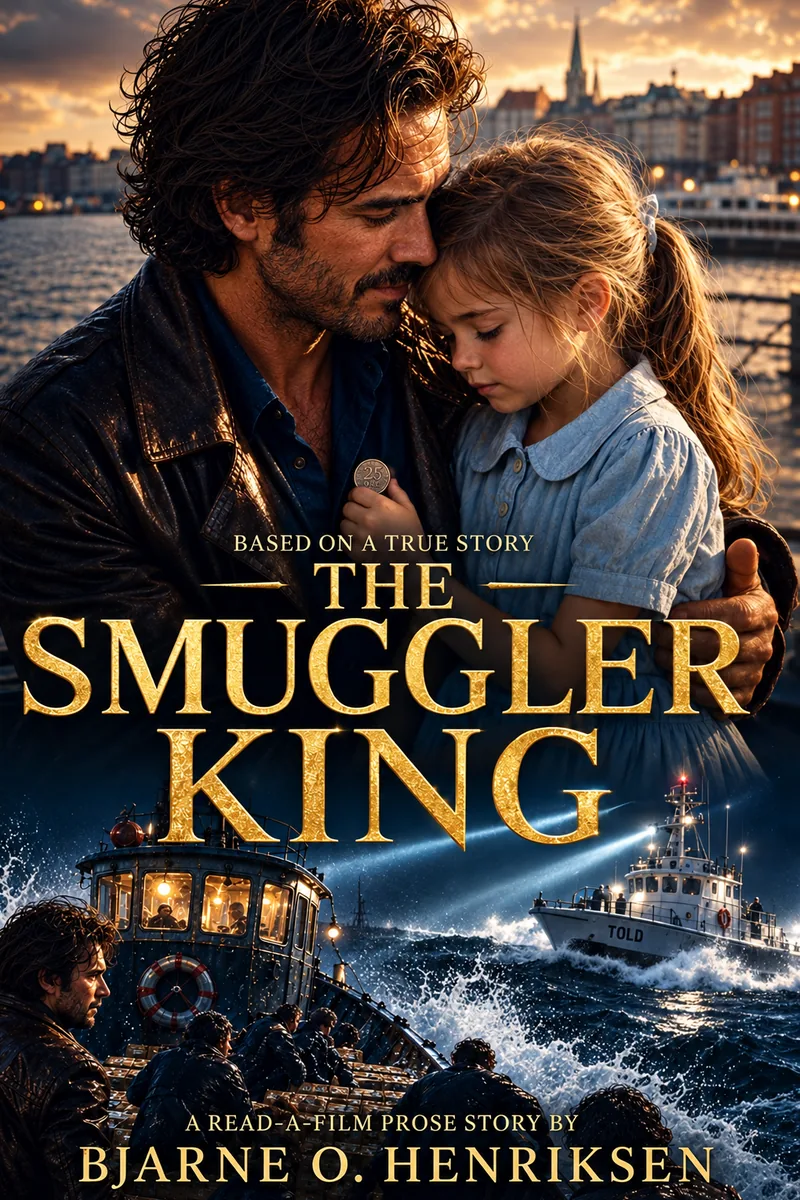
FEATURE FILM / LIMITED SERIES · 3 × 50 MIN
The Smuggler King
The true story of a battered Copenhagen boy who grows into Denmark’s audacious smuggling king — outwitting customs across the Cold-War Baltic until betrayal lands him in a Polish prison, where survival forces him to confront the child he spent his life trying to outrun.
- Comps
- Goodfellas · Catch Me If You Can · Midnight Express
- Genre
- Crime Epic · True Story · Caper · Period Drama
The story
Postwar Copenhagen. Seven-year-old Leon Owild is sent into the streets to sell his mother’s homemade slippers and steal whatever the household needs, then beaten whether he succeeds or fails. His mother burns him with an iron. His stepfather teaches him fear. Wealthier families teach him invisibility. The children’s home, reformatory and prison finish the lesson. By fourteen, Leon has reached a conclusion that will organize the rest of his life: if society insists on treating him as a criminal, he will become better at crime than the people judging him are at stopping it.
A generation later, Leon is known as the President — a charismatic Baltic smuggler building his own empire between Denmark and Communist Poland. He buys policemen, humiliates customs officers, turns teddy bears, fishing boats, fake film shoots and even a slow harbor tug into weapons of misdirection, and treats every border as a puzzle designed for him personally. The money is meant to prove something no amount of money can prove. To everyone else he is an outlaw folk hero. To his young daughter Laura, he is simply Dad — the one person before whom the performance keeps slipping.
Then betrayal sends Leon across the Iron Curtain and into Młynska 1, a Polish prison built to reduce men to obedience. The swagger cannot disappear, because swagger has always been one of his survival tools; neither can the violence, the cunning or the humor. But beneath all of them remains a worn twenty-five-øre coin he has carried since childhood — the coin he saw on the street below when, after his stepfather broke his nose, he stood on fourth-floor scaffolding with a noose and was about to end his life. That tiny glint gave him one more reason to stay. THE SMUGGLER KING becomes, finally, a father-and-daughter story about whether a man can stop passing his wound forward.
Comparisons & craft: how it reads on screen
The cleanest market comparison is GOODFELLAS meets CATCH ME IF YOU CAN — before the movie drives straight into MIDNIGHT EXPRESS. The first movement gives us the making of a criminal; the middle gives us the intoxicating pleasure of watching an operator become better at the game than the institutions chasing him; the final movement removes the game entirely. In Denmark and across the Baltic, Leon can turn nerve, speed, charm and absurdity into freedom. Inside Młynska 1, those same qualities become survival skills. The tonal shift is not a detour. It is the story proving what Leon’s charisma is actually made of.
The capers work because each one is also a portrait of Leon’s mind. A teddy bear crosses a border carrying contraband. Duck hunters become accidental decoys. A disastrous daylight landing at Bellevue is converted into a fake film shoot and a human chain. A slow tugboat becomes useful precisely because nobody believes a serious smuggler would choose one. Even the confrontation with customs at sea becomes an underwater escape problem. These are not interchangeable heists; they dramatize the habit Leon learned as a child in institutions — watch everything, identify the weakness, and turn the authority’s assumptions against it.
The hidden spine is Laura and the twenty-five-øre coin. After his stepfather breaks his nose, seven-year-old Leon runs to a construction site, climbs to fourth-floor scaffolding, makes a noose and prepares to end his life. Then he sees a shiny twenty-five-øre coin on the street below — something tiny and almost absurd, but enough to make the world seem not quite finished with him. He carries that coin through every institution, every beating, every border and every reinvention. Laura is the only relationship in which Leon is not calculating leverage. The “Pig Boy” bedtime story, the promised island, the zoo, the schoolbag and the coin all keep asking the same question beneath the criminal spectacle: can he give his daughter something other than the injury that made him? When Laura finally takes the coin because he no longer needs it, the gesture completes the character architecture: what once kept the abused boy alive can finally be released by the father he has become.
The directorial challenge is to let the audience enjoy Leon without acquitting him. He is funny, inventive, magnetic, brutal, selfish, loyal, dangerous and capable of extraordinary tenderness toward his daughter. The story explains where that contradiction came from without pretending explanation is absolution. That is the GOODFELLAS problem — screen pleasure versus moral cost — but here it is fused to a specifically Scandinavian outlaw wit and a Cold-War geography that suddenly becomes lethal when the rules change east of the Iron Curtain. The result is a crime epic whose biggest set piece is ultimately internal: an abused boy grows powerful enough to terrify governments, yet the real victory comes when the man can finally stop carrying the small talisman that once kept that boy alive.
Story Slate · The Smuggler King · Bjarne O. Henriksen · Confidential — for industry consideration