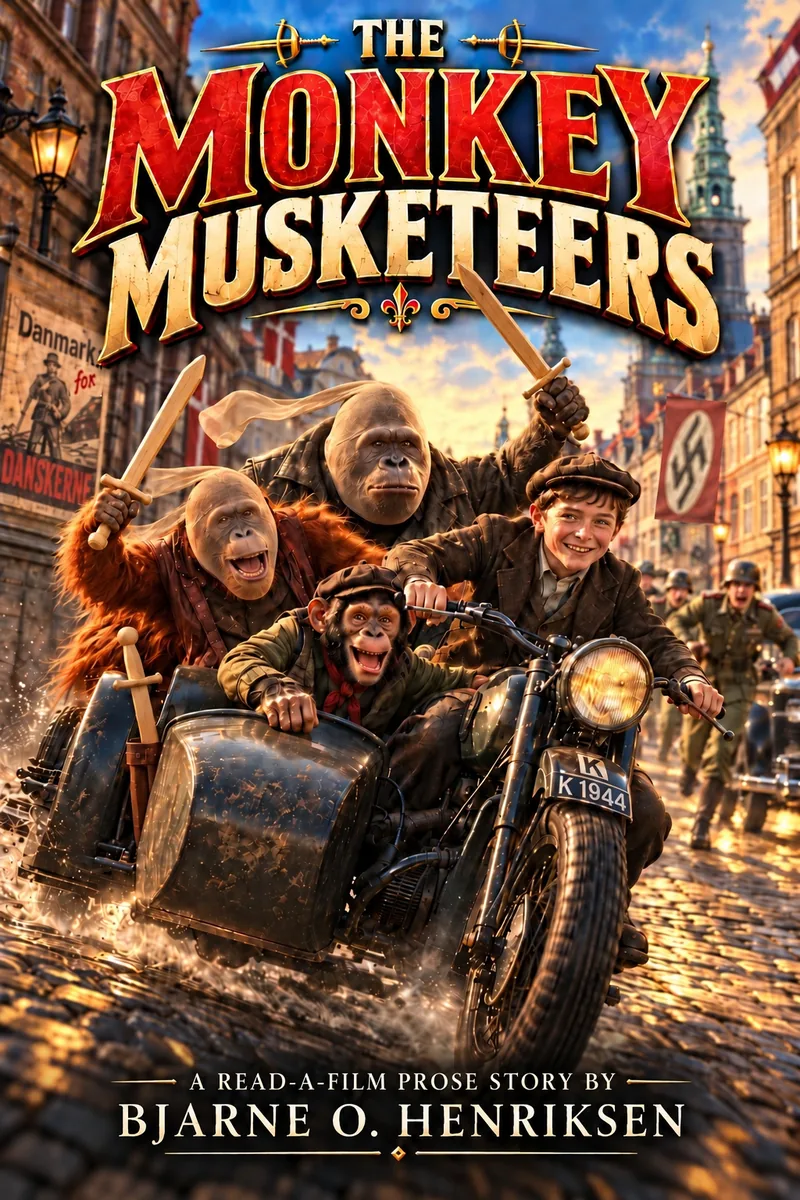
The Monkey Musketeers
In Nazi-occupied Copenhagen, a twelve-year-old boy who has secretly trained three zoo primates as his Musketeers turns their game into a real Resistance mission when the Gestapo captures his family and dozens of Danes bound for concentration camps.
- Comps
- the child’s-eye anti-Nazi tragicomedy of Jojo Rabbit · the wordless animal bond and separation/reunion emotion of War Horse · the ingenious resistance-caper machinery of The Great Escape
- Genre
- War · Adventure · Tragicomedy · Period
The story
Copenhagen, 1944. Twelve-year-old Jeppe Hytt-Hansen has read The Three Musketeers until the pages have gone soft, and through a loose board in the zoo fence he has created his own regiment: Porthos, a silverback gorilla; Athos, an orangutan; and Aramis, a chimpanzee. They fence, salute, steal German caps, and understand far more than the adults around them imagine. To Jeppe, they are Musketeers. To everyone else, they are animals.
Then the occupation breaks through the adventure. Jeppe discovers that his bricklayer father and zookeeper uncle are Resistance fighters, his family is on a Gestapo list, and captured Danes are being shipped toward concentration camps under a grotesque racial-classification program. When the adults are arrested, Jeppe and his three companions are suddenly the only team still moving. Their rescue runs through Copenhagen sewers, Gestapo headquarters, a Nazi funeral procession, the roof of a prison train, and finally a zoo storehouse where German discipline meets oil, feathers, machinery, manure — and three primates who have learned exactly how their enemies behave.
THE MONKEY MUSKETEERS is a wartime adventure told at the point where childhood imagination becomes moral courage. The comedy never makes the danger unreal; it makes the machinery of fascism look ridiculous while the people trapped inside it remain frighteningly vulnerable. Underneath the caper is a simple emotional story: a boy learns that being a Musketeer is not about pretending to be brave. It is about refusing to abandon your friends.
Comparisons & craft: how it reads on screen
The clearest screen lane is Jojo Rabbit meets War Horse, with the escape-engineering pleasure of The Great Escape. Like Jojo Rabbit, the occupation is filtered through a child who uses fantasy to make an unbearable adult world legible. But Jeppe’s Musketeer obsession is not merely comic delusion. It becomes a working moral code. The wooden sword, the salute, and “all for one” begin as play and end as the principles by which he acts when the adults disappear.
The animals are the emotional distinction. Porthos, Athos and Aramis never speak, and the prose never needs them to. Their intelligence is built behaviorally — imitation, observation, jealousy, humor, loyalty, grief. That puts the story closer to War Horse than to a talking-animal comedy. They learn Jeppe’s rituals because the rituals matter to him, then carry those rituals after he is gone. The final three-sword salute with an empty fourth position turns the adventure’s running joke into its deepest emotional image.
The action architecture belongs to the great resistance capers. The story keeps converting whatever is physically present into the next solution: a tranquilizer container becomes a raft; sewers become an escape route; Nazi headquarters becomes a hiding place; a funeral procession becomes cover; a casket becomes transport; a prison train becomes something a twelve-year-old can uncouple and redirect; a zoo storehouse becomes an improvised battlefield of oil, feathers, hoists, conveyor belts and manure. The comedy works like Lubitsch and silent-era physical farce: authoritarian ceremony keeps colliding with practical chaos, and the Nazis are repeatedly defeated by their own rigidity.
The coming-of-age turn gives the spectacle its weight. Early on, Jeppe casually repeats the language of “superior” and “inferior” races that surrounds him. By the time he tells the three primates that he belongs to no Superior Race and they belong to no Inferior one, the fantasy has matured into understanding. He saves his parents and the deportees, reaches Sweden, and has to leave his three best friends behind. A year later, after liberation, the monkeys still hold a place for a fourth Musketeer. Jeppe’s return with a stick and a bag of apples completes the image without undoing the separation that gave it meaning.
Story Slate · The Monkey Musketeers · Bjarne O. Henriksen · Confidential — for industry consideration