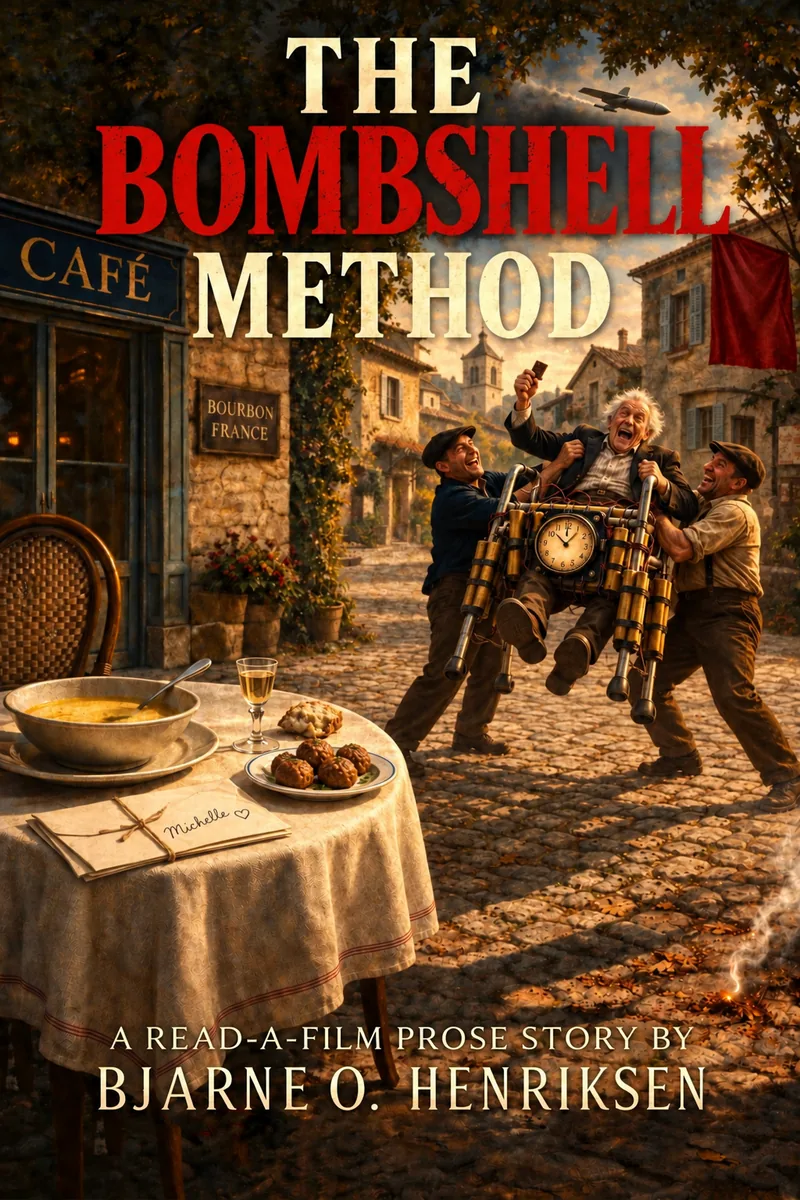
FEATURE FILM / LIMITED SERIES · 4 × 50 MIN
The Bombshell Method
Jojo Rabbit by way of La Grande Vadrouille — an American army psychologist who cannot say no to a beautiful woman is dropped into occupied France to stop the V-bomb aimed at London, where his wife and son have just landed.
- Comps
- the tonal braid of Jojo Rabbit — farce and heartbreak in the same beat · the occupied-France ensemble tradition of La Grande Vadrouille · a Catch-22 prose-engine resolving into Grand Budapest melancholy
- Genre
- War · Comedy · Period · Ensemble
The story
Bourbon, France, June 1944. The village Resistance has just assassinated a German engineer with a bowl of soup, a plate of meatballs that are emphatically not pork, and a glass of schnapps — and the Gestapo has shot the two men responsible against the church wall. Both are alive. Their executions were staged by a British bomb expert who did special effects in pictures before the war, on the theory that dead men move freely. It is the last thing in Bourbon that will go according to plan.
Three thousand miles away, Major Sam Carter teaches psychological warfare and manages a classified condition: he cannot say no to a beautiful woman. He is sent to France to find out why the Bourbon Resistance stopped fighting and to destroy the V-bomb plant aimed at London — and works out, too late, that he was chosen because his wife and son are flying there for a wedding. He has two days. The Resistance has spent four years of occupation shooting at each other over one woman. And that woman is being blackmailed by the Gestapo to keep it that way.
BOMBSHELL is a war comedy with a working heart — an escalating farce of forged love letters, funerals attended by the deceased, a fencing duel fought while both men hold up their own trousers, and a Lancaster bomber with the wings sawn off. Underneath it runs something quieter: a woman performing her own beauty daily to keep her father alive, and a boy on the steps of St Paul’s who hears what nobody else at the wedding can hear.
Comparisons & craft: how it reads on screen
The engine is Catch-22 — and not loosely. The story announces it in its first sentence: the German Engineer must finish his soup before Old Dupont can kill him, and Old Dupont must kill him before he finishes it. That is Heller’s title-logic run deliberately through a meat grinder, and it sets the contract for everything after — a war rendered as a closed loop of absurd, self-cancelling logic, narrated by a voice that treats atrocity and bureaucracy with exactly equal deadpan. The piece runs three registers at once: Ridiculous, Ruthless, and Rueful.
Ridiculous is the surface and the engine. The voice is a three-way braid of Heller, Douglas Adams, and Terry Pratchett — fake-precise, euphemism-besotted, dropping absurd statistics with a straight face. On screen, the image-register is Looney Tunes physics in uniform: the Engineer who “did not so much explode as stop being continuous,” and above all Old Dupont, who survives three firing-squad volleys, returns fire with an 1898 pea shooter, and attends his own funeral. The closest tonal screen-cousins are the Mel Brooks / Monty Python Allied-farce mode and, most exactly, ’Allo ’Allo! — the occupied-France café, the resistance of lunatics, the comic-menacing Germans.
Ruthless is the cruelty handled as farce, and here the sharpest comparison is Armando Iannucci’s The Death of Stalin: violence genuinely lethal and genuinely funny in the same beat, where the joke is the gap between procedure and slaughter — “death was not merely a biological condition. It was an official designation.” The prestige cousin it keeps brushing against is Inglourious Basterds: the cathartic, slightly operatic revenge impulse, and the crosscut climax that detonates a sealed enemy room while an oblivious ceremony proceeds elsewhere.
Rueful is where the piece becomes more than its lineage. The Michelle thread does del Toro / Atonement work inside a Brooks comedy — real, and tender, and earned. And the ending tips the whole thing into Wes Anderson’s The Grand Budapest Hotel: the melancholy always running under the symmetrical whimsy surfaces at the close, the narrator’s fond precision turning elegiac, the comedy resolving not into a gag but into “the particular species of happiness that consisted primarily of recognizing what one had.” The final image — the pill bottle, the copy of Psychological Warfare as a paperweight, “It had not helped” — is the rueful key the whole piece was secretly in.
The original fusion: a Catch-22 prose-engine driving a Looney Tunes war, narrated in the deadpan of Adams and Pratchett, that keeps accidentally telling the truth — and then, unlike almost every war farce, lands not on apocalypse (Strangelove) or uplift (Brooks) but on a quiet, Wes-Anderson-grade elegy. A comedy about everything that doesn’t work — the marriage, the medication, the expertise, the war itself — that earns a real sadness. The most cartoonish possible machine resolving into a genuinely melancholy final frame: that is the thing that makes it more than the sum of its very visible touchstones.
Story Slate · The Bombshell Method · Bjarne O. Henriksen · Confidential — for industry consideration