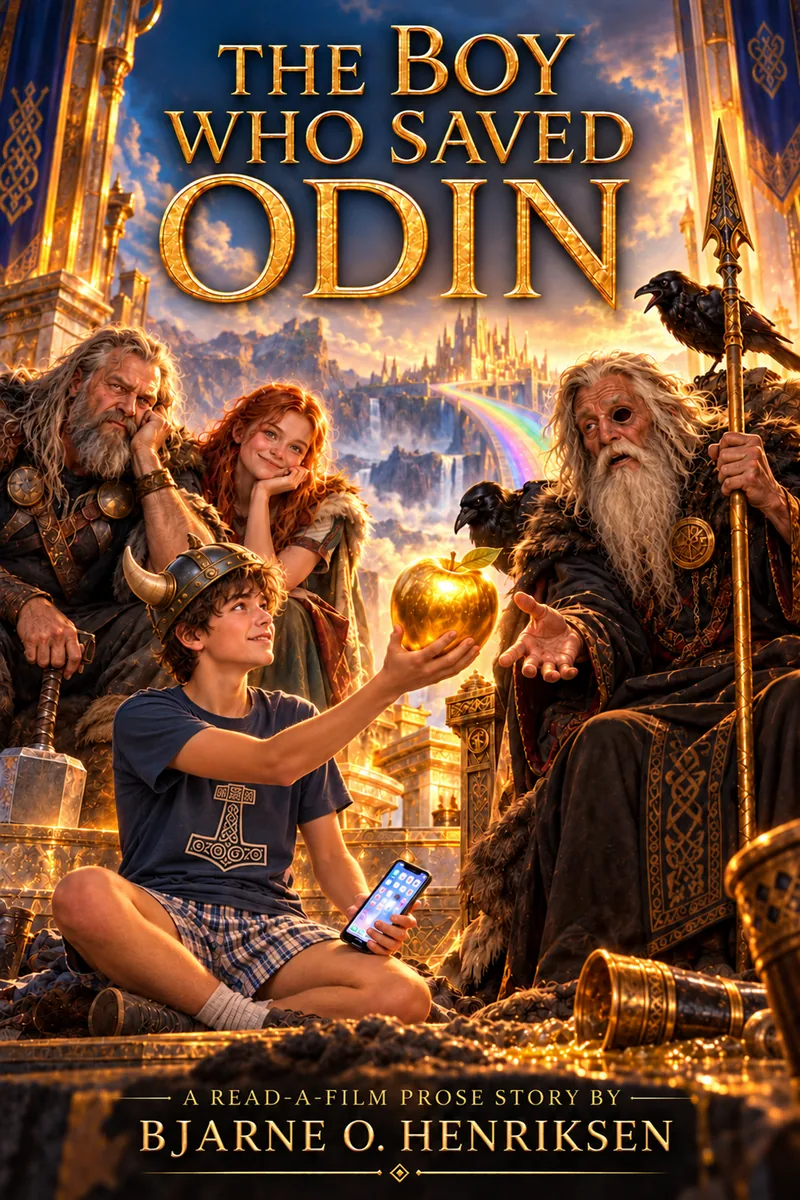
The Boy Who Saved Odin
A Norse-mythology-obsessed Danish teenager is carried into a dying Asgard, where stolen immortality, an army of giants, and an enemy boy wearing his face turn a rescue quest into the mystery of his own lost twin.
- Comps
- Percy Jackson · Thor: Ragnarok · How to Train Your Dragon
- Genre
- Fantasy Adventure · Coming-of-Age · Mythic Comedy · Family
The story
Oskar is fourteen, Køge's resident Norse-mythology obsessive, a gifted soccer player, and the only boy at school who can explain Yggdrasil faster than most people can open TikTok. On his birthday, a thunderstorm brings the real Thor to his garden and carries Oskar into Asgard, where the gods are aging by the hour. Idun and her youth-giving apples have vanished, Utgard-Loki is gathering an army for Ragnarok, and the supposedly all-powerful gods are suddenly too old to save themselves.
Paired with Trud — Thor's daughter and the impossible goddess Oskar has worshipped from a bedroom poster — he crosses the Iron Forest, the Realm of Death, Jotunheim and the sea beyond the worlds, surviving on exactly the thing everyone on Earth treated as useless trivia: what he knows. But the enemy's young champion, Tjalfe, has Oskar's face. A birthmark finally reveals why. Tjalfe is Torben, the identical twin stolen from Oskar's hospital crib during the blackout on the night they were born — and the brother Oskar's family has mourned for fourteen years.
By the time Asgard falls under siege, Oskar is no longer the fan visiting his favorite mythology. He is inside the myth, changing it — improvising with an iPhone, soccer instincts, dwarven weapons, a shirt full of apples and one last impossible throw to save Odin and the Nine Realms. He returns to Køge with his family restored to him but not yet complete: Trud can still call across worlds, Torben is alive somewhere beyond them, and the secret connecting Oskar's mother to Asgard has only begun to surface.
Comparisons & craft: how it reads on screen
The governing comparison is Percy Jackson — a contemporary teenager enters a living mythology and discovers that the knowledge that made him look obsessive at school is exactly what makes him useful when the myths become real. But the Danish specificity gives it its own identity: Køge school politics, birthday flags, an overdue library book, an iPhone crossing the Nine Realms, and a family on Earth trying to explain impossible goat prints while their son is being recruited by gods. Oskar does not merely discover mythology; he gets to correct it, argue with it and eventually change it.
Thor: Ragnarok supplies the comic register: divine grandeur continually punctured by petty behavior, vanity, alcohol, bureaucracy and old gods who are considerably less impressive in person than they were on Oskar's posters. The crucial difference is that the aging is not just a gag. Idun's missing apples turn the comedy into a visible clock. Thor goes gray, Odin becomes frail, and Trud ages in front of Oskar until the fourteen-year-old goddess he adores is suddenly older than his own mother. The mythology itself supplies the stakes.
How to Train Your Dragon is the emotional comparison — not because of an animal companion, but because the large-scale fantasy works only if the intimate coming-of-age story stays underneath it. Oskar begins as a boy in love with the idea of gods and heroes. The journey teaches him that heroes are tired, frightened, jealous and fallible, and that knowledge matters only when it becomes courage. The strongest turn is Tjalfe becoming Torben: the hostile double is not a rival to defeat but the twin brother stolen from the family. When Torben finally asks the smallest possible question — his mother's name — the adventure finds its real heart.
The craft challenge is balance: Asgard has to retain genuine wonder and danger even while Oskar talks in gamer metaphors and uses a camera flash against the Midgard Serpent. The wisecracks should release pressure, not flatten the myth. The story also uses apples with unusual precision: Idun's fruit represents impossible divine youth; Jette's ordinary bitten apple remains a grounded Earthly counter-image; and Oskar's love for Trud survives rather than resolving into a conventional 'real girl versus fantasy girl' choice. The first adventure closes cleanly with Odin saved, while Torben's fate, Frigg's cryptic knowledge of Oskar's mother, Trud's cross-realm phone call and Utgard-Loki's survival create a continuation engine already embedded in the ending.
Story Slate · The Boy Who Saved Odin · Bjarne O. Henriksen · Confidential — for industry consideration