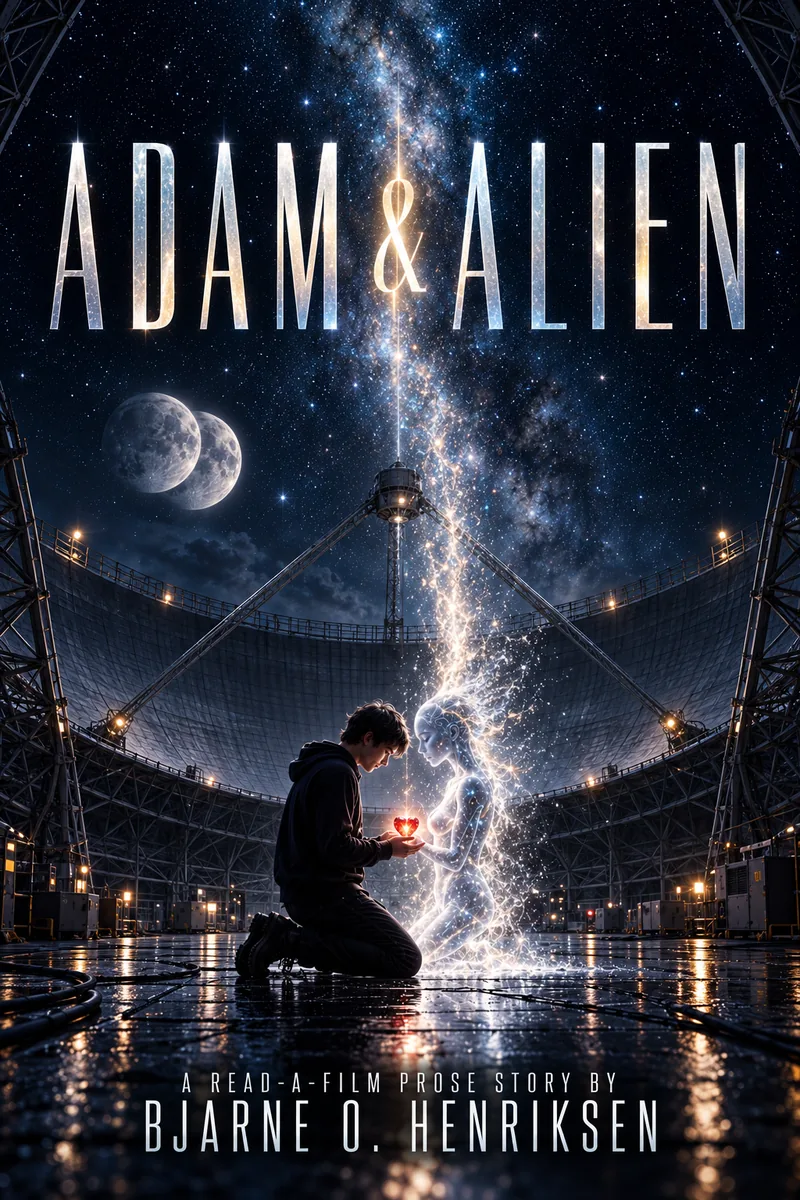
Adam & Alien
Arrival meets Midnight Special — our alien forefathers return to end their failed experiment: the human race, created to test the emotions they erased from themselves millions of years ago. But when the alien girl Molis begins to feel after meeting the grieving teenager Adam, they become humanity’s last chance.
- Comps
- the cerebral-emotional first contact of Arrival · the soulful genre grief of Midnight Special · a believer vindicated, in the key of Contact
- Genre
- Sci-Fi · First Contact · Drama · Romance
The story
Seventeen-year-old Adam Haller is the keeper of his late father’s disgraced obsession — a theory that the ancient myths of gods descending in beams of light were never metaphor, but a record of something real. His father believed creation itself was an instruction spoken aloud, and that whatever could speak a world could also unspeak one. Everyone called him mad. Adam, carrying his own private grief, is the only one still listening when a second moon appears in the sky over Oregon.
It isn’t a moon. What descends with it makes contact with the one person on Earth primed to understand it — and brings with it a force that intends to reach all the way back to the world’s first word and take it out, letting everything spoken after it fall quietly into nothing. A laughed-at astronomer, a government agent forced to choose between her institution and her instincts, a boy, and the luminous being who came for him become the last line between creation and silence — and the cost of keeping the world speaking will be paid by the one least able to bear losing anything more.
ADAM & ALIEN is a soulful first-contact drama about grief, meaning, and the choice to keep the world — proof that the most cerebral science fiction can also be the most tender, and that the oldest stories may have been describing the method all along.
Comparisons & craft: how it reads on screen
The governing comparison is Spielberg’s Close Encounters and E.T. run through Denis Villeneuve’s Arrival — a suburban-American first-contact story in which the aliens are a mystery to be understood rather than fought, Spielberg’s warmth married to Arrival’s cool, idea-driven dread: contact as a problem of communication, time and meaning bending, a woman at the center who feels what her institution cannot. What makes it its own thing is that the first-contact film is welded to an intimate story of inherited grief. It runs three lenses: Tender, Cosmic, and Bereft.
Tender is the texture — pure Amblin. The Burmese cat, the Portland cul-de-sac with its breathing lawns, the dead father’s home movies, the alien girl whose forearm hairs rise the first time she feels something. The boy-and-his-impossible-friend spine is E.T. outright; the lonely-believer-vindicated thread — an astronomer at his fifty-year-old dish, humming Wagner, mocked by the janitor — is Close Encounters’ Roy Neary crossed with Contact’s Ellie Arroway. On the page the voice is more literary than Amblin: a dry, fastidious, cosmic narrator (fire “becoming torches with the casual authority of chemistry showing off”) in a Vonnegut-deadpan register, here pointed at awe instead of farce.
Cosmic is the structure — hard-SF idea-horror. The aliens as dispassionate farmers, humanity as a crop that drifted past its design and so must be closed — “not malice, that is method” — is Arthur C. Clarke and the cold sublime of 2001, with the specific chill of Peter Watts’ Blindsight: intelligence without empathy as the truly alien thing, a species that engineered feeling out of itself. The reveal that a past extinction was a previous harvest is Lovecraftian deep-time as plot mechanism. And the climax — a war fought not with weapons but by rewriting the instruction in transit, creation and un-creation as the same beam carrying a different word — is Arrival’s “language is the weapon” thesis pushed to a theological extreme, by way of the Genesis frame the epilogue makes explicit.
Bereft is where it’s most itself: beneath the spaceship, a son inheriting a disgraced father’s belief and discovering the father was right — the reconciliation-with-a-dead-difficult-parent of Field of Dreams and Big Fish. The alien plot rhymes exactly onto the human one — a being who engineered away its own capacity to feel, and the one in whom it failed, mapped onto a father and son and a repression finally broken. The film’s deepest move is that the cosmic and the domestic are one diagnosis, and its single original fusion follows from it: a Spielberg first-contact movie rebuilt on Arrival’s idea that creation is an instruction spoken aloud — so the alien apocalypse and a son’s grief turn out to be the same sentence read two ways, where saving the world means rewriting one word in transit, and the boy who once felt most lost becomes the choke point that keeps the world speaking. The ambition it asks of its director is to hold the cosmic spectacle and the intimate grief in perfect balance so neither cancels the other — and to land, as the script unmistakably does, on a clear and lifeward verdict: a story of return, of choosing the world, that earns its wonder by meaning it.
Story Slate · Adam & Alien · Bjarne O. Henriksen · Confidential — for industry consideration