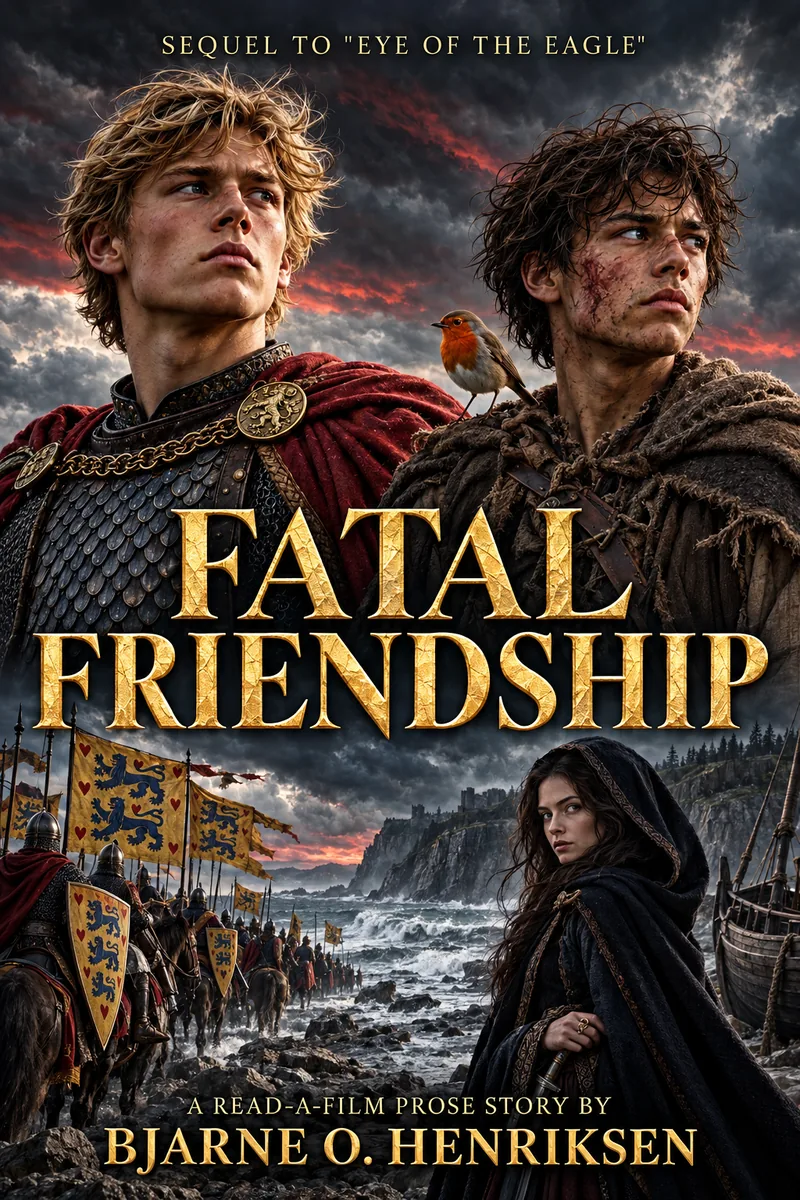
FEATURE FILM / LIMITED SERIES · 3 × 50 MIN
Fatal Friendship
The continuation of the Golden Bear–nominated Eye of the Eagle — when a kitchen boy is abducted in place of Denmark’s young prince, left for dead and stripped of his memory, the two friends must find each other again inside a German castle where an imperial conspiracy is preparing to kill both the prince and his father.
- Comps
- The Princess Bride · The King · The Three Musketeers
- Genre
- Historical Adventure · Coming-of-Age · Friendship · Court Intrigue
The story
The story that began in Eye of the Eagle rides east. King Valdemar the Victorious is expanding Denmark across the Baltic, while his fifteen-year-old heir is being trained to believe that affection is weakness and a king survives by trusting no one. Beside him rides Aske — kitchen boy, squire and the only person who still calls him Valde. But rank is beginning to pull the boys apart just as Emperor Frederick II, unable to stop Denmark in the field, begins building a conspiracy around Count Henrik of Schwerin, bought nobles, assassins and divided loyalties.
At Reval, the trap takes the wrong boy. Aske is seized in the prince’s place, condemned, nearly burned with the dead and escapes into the forest with no memory of who he is. Taken in by a kitchen family at Schwerin, he becomes Joswig. Young Valdemar, believing his friend died for him, spirals into guilt and self-destruction — until his father sends him away to the very castle where Aske is alive. Valdemar recognizes him. Aske does not. Their friendship must begin again while neither boy understands that Schwerin itself is the center of the plot against Denmark.
As a coronation approaches, high politics and low-born improvisation collide: secret passages, poisoned rings, hidden weapons, a stolen herring, a bag of pepper and a soup recipe all become part of the same machinery. When Aske finally recovers his memory, he races to warn the newly crowned Valdemar — only to discover that the prince has learned his father’s most dangerous lesson too well. FATAL FRIENDSHIP becomes the story of a future king choosing between inherited suspicion and earned loyalty, and of two boys who must decide whether friendship can survive war, class, betrayal, lost memory and a crown.
Comparisons & craft: how it reads on screen
The cleanest screen lane is The Princess Bride meets The King, with the conspiracy momentum of The Three Musketeers. The Princess Bride supplies the youthful adventure, irreverent banter, grotesque supporting characters and the pleasure of serious danger sharing the frame with comedy. The King is the more important psychological comparison: this is the education of a teenage ruler under a father who believes isolation is strength. The Three Musketeers speaks to the engine underneath both — loyalty, secret alliances, assassination plots and friendship tested against power.
The central craft device is separation followed by unequal recognition. At Reval, Aske is taken because the enemy mistakes him for the prince. Valdemar believes his best friend has died for him and begins collapsing under the guilt; Aske survives, loses his name and becomes Joswig inside a new found family. When the boys meet again at Schwerin, only Valdemar knows they have a history. That makes every comic escape, argument and moment of instinctive loyalty do double duty: Valdemar is trying to recover a friendship Aske does not remember, while Aske is unknowingly becoming the same friend all over again. By the time memory returns, the story has made the relationship earn itself twice.
The political thriller is deliberately fought from below. Emperor Frederick II, Count Henrik, Plötz, Schwartzkopf and Lia move armies, nobles and assassination plans; the boys move through kitchens, markets, middens, ruined passages and fireplaces. A bent fork opens a locked door. Pepper defeats Iron Nose. A stolen herring protects a king’s soup. A recipe becomes an escape from a dungeon. These are not comic detours from the conspiracy — they are how the conspiracy is beaten. The story repeatedly lets grand strategy collide with the practical intelligence of people history normally leaves outside the chronicle.
The title resolves in a choice of governing philosophy. King Valdemar teaches his son that a ruler can trust no one but himself. Aske gives him the opposite lesson: real friendship is dangerous precisely because it requires trust, but refusing that risk leaves a crown standing alone. The coronation therefore becomes more than ceremony: the new Co-King’s first real test is whether he will judge Aske by appearances and inherited suspicion, or trust the boy who has already saved him. In the climax, that decision carries both boys through the hidden passages and into Lia’s assassination attempt.
The ending wisely stops before the famous Lyndanisse miracle rather than pretending this story is the miracle itself. The army rides east toward the 1219 battlefield, while Young Valdemar’s epilogue contrasts what official chronicles will record with the smaller truths they will omit: Caesar, soup, a kitchen boy, and the friend who taught a future king that courage can mean refusing to walk away from someone. That gives FATAL FRIENDSHIP a complete emotional ending while leaving history — and the larger saga — visibly ahead.
Story Slate · Fatal Friendship · Bjarne O. Henriksen · Confidential — for industry consideration