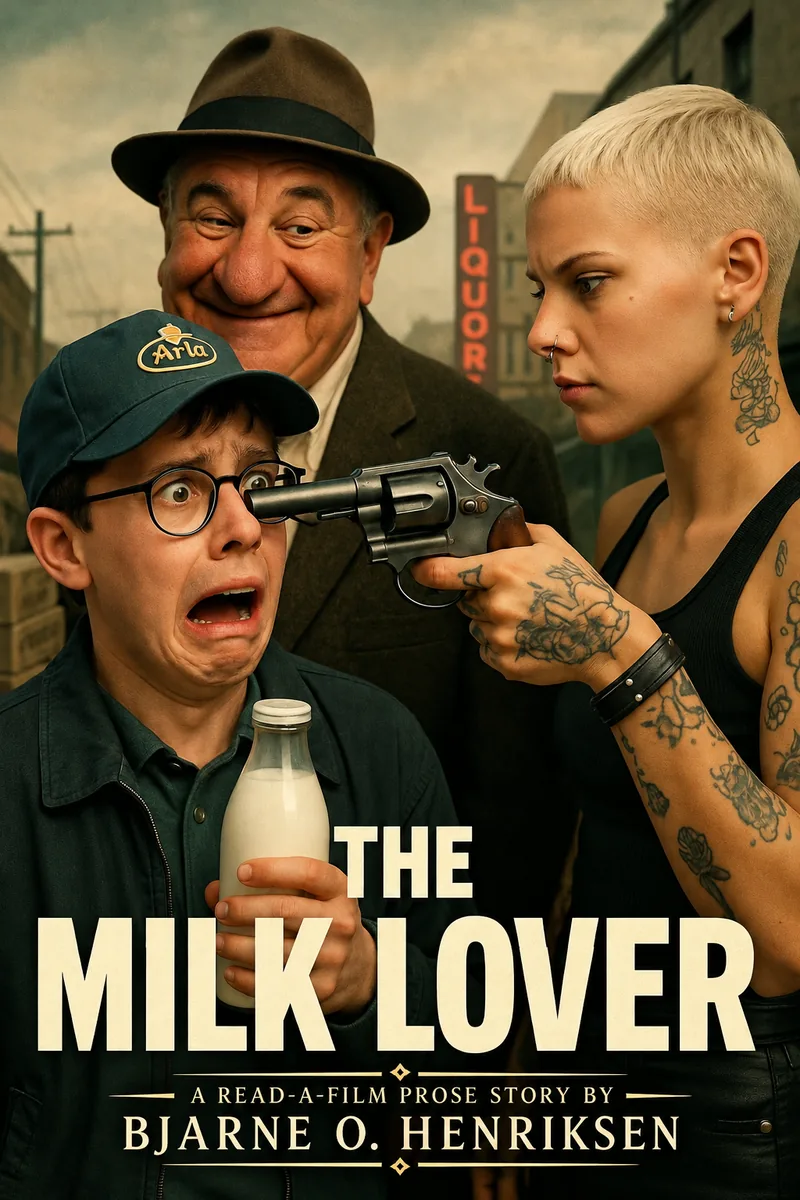
The Milk Lover
A painfully sheltered thirteen-year-old raised on low-fat milk, classical music and fear of alcohol is swept into a Scandinavian smuggling war by a runaway girl from a youth treatment center — and discovers that growing up means facing the world without the rituals that once kept him safe.
- Comps
- Moonrise Kingdom — two damaged young outsiders escaping adult rules into a private alliance the grown-up world cannot understand · Raising Arizona — manic crime-caper escalation, grotesque supporting characters and physical comedy engineered with precision · My Life as a Dog — Scandinavian child-eye melancholy, resilience and painful material carried with lightness rather than sentimentality
- Genre
- Coming-of-Age · Crime Caper · Road Movie · Tragicomedy
The story
Alfred Fondue-Sørensen is thirteen and has been protected from life with military precision. His formidable mother Brenda has organized his existence around low-fat milk, classical music, agreements, punishments and the conviction that alcohol is civilization's shortest route to ruin. When fear overwhelms him, Alfred uses a trick learned from a book on Tibetan monks: he recites a phrase and a single date appears before him, hovering in the air until calm returns. Sent alone to Bisserup for a supposedly wholesome summer holiday, he instead witnesses a liquor delivery and collides with Ursula Stenson — fourteen, platinum-haired, armed, escaped from a treatment home and convinced the smugglers who killed her boyfriend can be found on the Swedish island of Hven.
Ursula hijacks Alfred into a pursuit that tears through every rule he has ever lived by. He learns to drive in a fleeing smuggler's van, tastes alcohol for the first time, hides Ursula in his parents' apartment, escapes through a church funeral in a stolen hearse and crosses Øresund while police, smugglers and Ursula's estranged father close in. At the center of the operation is Carl Lafong, a wheezing W.C. Fields of a criminal who plans to flood Scandinavian schools with John Wayne Whisky. As the danger grows, Alfred's private magic begins to fail. The date flickers, disappears and finally refuses to return — just as the terrified boy who once needed it begins making decisions for himself.
At Uranienborg, Alfred faces Lafong, saves Ursula and helps destroy the smuggling operation. But the emotional resolution is quieter. Alfred has been damaged by too much protection; Ursula by too little love. Each has mistaken a parent's failure for a rule about the world. By the final cemetery scene, Alfred still loves milk and Ravel, Ursula is still irreverent, and neither has become the other's opposite. What has changed is proportion. THE MILK LOVER is an anarchic Scandinavian coming-of-age caper about first love, bad parents, childhood magic and the moment safety stops meaning never taking a risk.
Comparisons & craft: how it reads on screen
The clearest commercial lane is Moonrise Kingdom crossed with Raising Arizona. Alfred and Ursula are two young people whose private logic makes more sense to them than the adult world pursuing them. But the storybook symmetry keeps colliding with Coen-like machinery: a smuggler in a phone booth, a submerged van full of whisky, an illicit Bordeaux education, a family misunderstanding involving a straitjacket, a funeral converted into transportation, a ferry escape, artificial breasts with an unexpected second function and finally a sword duel against a villain who needs an oxygen tank between attacks. The absurdity is not decoration; it is the propulsion system.
The deeper emotional design is built around opposite failures of parenting. Alfred has been loved so protectively that fear has become his mother's inheritance to him. Ursula has been neglected so completely that she has learned to treat self-destruction as independence and love as something likely to disappear. Brenda tries to prevent every danger; Christian Stenson has been absent from the dangers that mattered. Their children meet in the middle. Alfred discovers that care without freedom becomes control, while Ursula discovers that freedom without care can become abandonment. Their bond works because each accidentally supplies what the other has been missing.
The date is the story's most elegant piece of visual writing. At the beginning, Alfred can literally materialize a date whenever panic overwhelms him — childhood self-soothing made visible. Once the adventure becomes real, the spell begins to fail. On the beach, after the van crashes into the water, the date flickers and disappears; Alfred realizes it is gone 'the way childhood illnesses disappear and never return,' and then gets up and carries Ursula away anyway. The key is that the symbol is not simply mourned. In the final scene the date returns in comic, physical form as a 'health cigar' made from dates, shared with Ursula. What was once private magic becomes ordinary pleasure between two people. Growing up has not destroyed enchantment; it has changed where Alfred finds it.
The ending refuses the easiest version of rebellion. Alfred does not become a drinker, reject classical music or discover that his mother was wrong about everything. Ursula does not become a model patient. The final joke — tasting skim milk and concluding that 'there's no reason to be fanatical' — quietly states the whole film. Maturity is not replacing one absolute with its opposite. It is learning proportion. That is why the cemetery, Ravel and the two date cigars land more deeply than a conventional victory lap: after all the guns, chases and exploding whisky, the boy who began by needing a magical object to survive fear can finally sit still beside another person and let the world remain imperfect.
Story Slate · The Milk Lover · Bjarne O. Henriksen · Confidential — for industry consideration