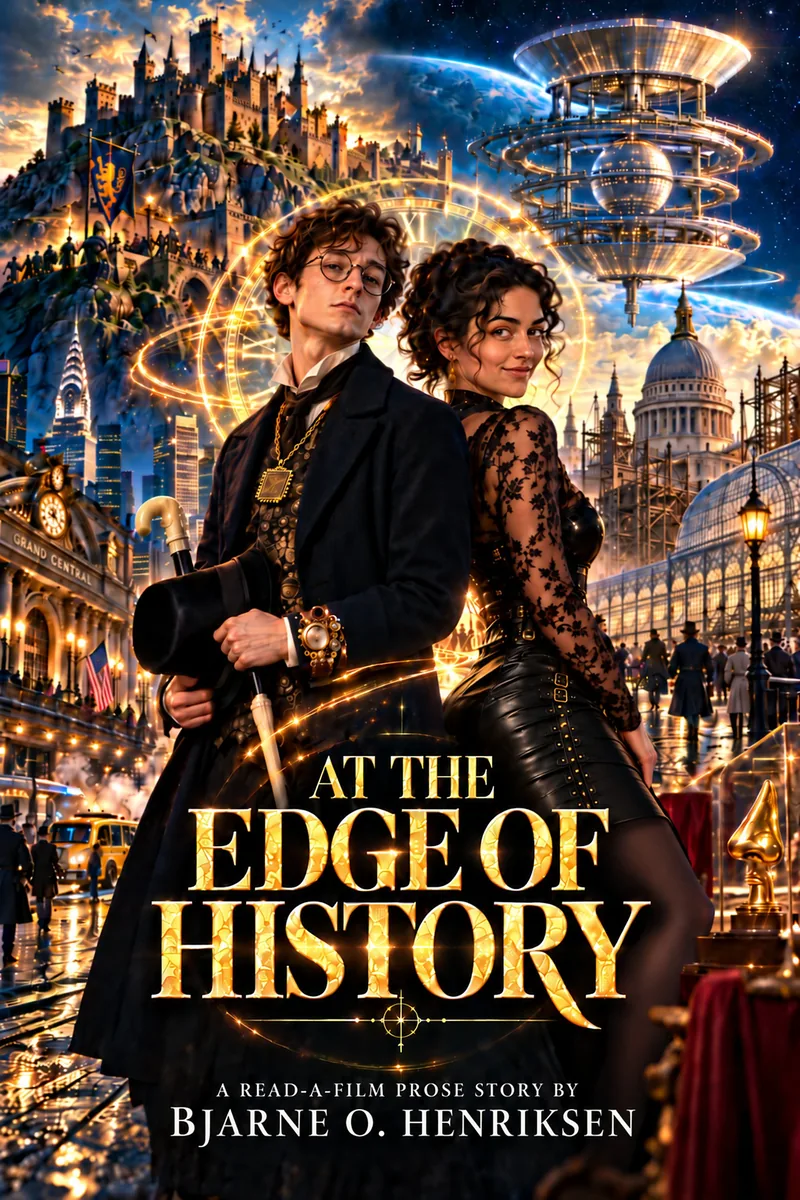
FEATURE FILM / LIMITED SERIES · 3 × 50 MIN
At the Edge of History
Back to the Future directed by Terry Gilliam — a deadpan heir, a wristwatch that rewrites history, and the one man too well-mannered to use it.
- Comps
- Time Bandits · Back to the Future by way of Candide · The Hitchhiker's Guide with a Wodehouse butler
- Genre
- Sci-Fi · Time Travel · Comedy · Adventure
The story
Aaron Randolph can date a medieval chest at a glance and has never so much as held a girl's hand — a five-hundred-year-old family law sees to that. So on one unsupervised Friday afternoon he slips downtown to break the rule, and instead breaks history: a dying stranger presses a clunky digital watch into his pocket, gasps that humanity is counting on it, and is shot dead in the street. Ten panicked minutes later Aaron and a sharp-tongued downtown stranger named Maria are no longer in New York. They're in the year 1225.
The watch is a Timepiece, and everyone wants it. A smiling agent who guards the shape of history. A nose-obsessed baron who burns guests for sport. A bumbling space-colony enforcer terrified of his next demotion. As Aaron is flung from a medieval crusade to a gleaming orbital city to the fog of Victorian London, he discovers two secret factions at war over a single question — whether the future should be rewritten by the people clever enough to do it — and that the answer may come down to the least likely man alive to decide it.
AT THE EDGE OF HISTORY is a time-travel comedy about whether the world is ours to redesign — and the quiet, stubborn courage of choosing to leave it exactly as it is.
Comparisons & craft: how it reads on screen
The governing comparison is Terry Gilliam’s Time Bandits, if its soul were Voltaire’s Candide. The era-hopping picaresque, the grotesque-comic set-pieces, the off-screen war between cosmic factions over the shape of reality, and the unsentimental gut-punch ending all come from Gilliam’s playbook. But the engine underneath is the conte philosophique: a guileless innocent dragged station to station through history while a serious argument runs beneath the slapstick, each stop both a sketch and a turn of the philosophical screw. It runs three registers: Imperturbable, Picaresque, and Counterfeit.
Imperturbable is the texture and, cleverly, the plot mechanism both. The comedy is built on a man who will not react — Aaron narrates his own kidnapping like a furniture appraisal, and “a Randolph does not feel emotion” is the load-bearing joke. The register is pure Wodehouse (Macintosh isn’t like Jeeves, he is Jeeves, down to the alibi-construction) crossed with the cosmic-bureaucracy deadpan of Arthur Dent and the stone face of Buster Keaton. The flat affect isn’t just a voice — Aaron is the still point the chaos spins around, which keeps every escalation legible, and the script later weaponizes it: he’s the perfect alibi precisely because he doesn’t behave like a man who knows he’s in danger. The character trait and the heist depend on each other — a rare, clean texture-to-structure weld.
Picaresque is the costume box: 1225 boar-jousting and thrown halibut, a smiling functionary’s hidden rock-office served by 19th-century footmen, a 2051 orbital colony (the “Crystal Palaces” lifted straight from the NASA-Ames colony paintings — on screen, the torus of Interstellar or Elysium), then fog-bound 1851 London. This is the Candide itinerary, and its standout is the Hartkopf dinner — a genial interrogation over wild boar and an 1868 red that is the Hans Landa strudel scene from Inglourious Basterds almost beat for beat: warmth as the delivery system for menace. Counterfeit is the paranoia humming under all of it — everyone is a fake or in disguise, the watch that’s “just a watch,” the smiling agents who could be killers — and structurally it’s the long con: the whole picaresque snaps retroactively into a heist in the recognition architecture of The Sting, sealed by a closed time loop worthy of Back to the Future Part II. The richest irony: the connoisseur whose entire expertise is spotting counterfeits is himself the planted fake, and never catches it — a blank innocent the world projects onto, Chauncey Gardiner from Being There with a wristwatch.
The ambition it asks of its director is to play the long game with conviction: a hero whose only stated want is to get home by 2 p.m. is a deliberately tiny engine, the year-long master plan withheld until the end, so the film rewards a director who trusts the deadpan to carry the rising line and who grants the female lead — revealed to have been running the whole con — the full interiority the reveal sets up, turning the romance into a genuine two-hander. Its single original fusion: the gag and the argument are the same machine — a screwball time-caper that resolves into a conte philosophique, where the do-nothing dandy’s refusal to act is at once the running joke, the obstacle to the romance, and the moral thesis, and where a piece of tasteless costume jewelry, not heroism, saves the world.
Story Slate · At the Edge of History · Bjarne O. Henriksen · Confidential — for industry consideration