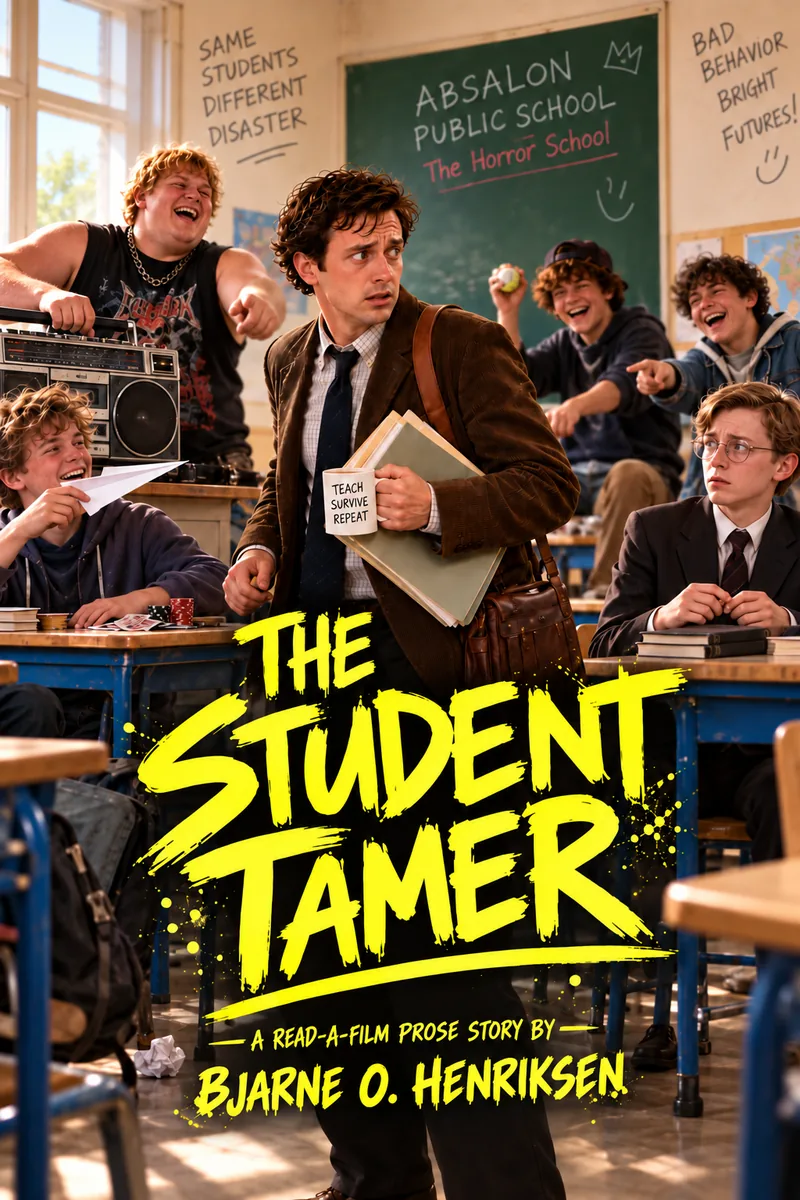
The Student Tamer
To Sir, with Love directed by the Coen brothers — a timid little man is handed the worst class in the country, and discovers the only way to teach them is to tame them.
- Comps
- To Sir, with Love played as farce · Fawlty Towers inside a school for the unteachable · a Tom Sharpe satire with a lion-tamer’s heart
- Genre
- Comedy · Institutional Satire · School Comedy · Underdog
The story
Norman Lund never wanted to be a teacher. He wanted to be an Italian movie star. But a brutal job market lands him a tenured post at Absalon Public School — the institution built to contain the children no other school will take, known everywhere as the Horror School. His class is 9.L: six pupils, ten hospitalized teachers, and a private betting pool on how many days the new one will survive. Norman arrives with exactly two useful qualifications: a film buff’s understanding of how Humphrey Bogart takes control of a room, and thirty years of hand-to-hand combat with his magnificently impossible mother. What he can’t do is teach them. So he tames them.
Reading 9.L like a pack — alpha, followers, scapegoat — Norman goes to psychological war. He turns the bullies against their leader, gives the class tyrant just enough responsibility to expose himself, and refuses, hour after hour, to become teacher number eleven carried out on a stretcher. By the end of his first day, an alcoholic principal who hides his sherry inside Kierkegaard, a fascistic vice-principal plotting a coup, and an entire faculty cowering in the staff room have transformed one classroom standoff into a full-scale siege involving barricades, megaphones and riot police.
THE STUDENT TAMER is a fast, ferocious institutional comedy about an apparently hopeless class, the adults who have failed them, and a man who discovers that authority is not the same thing as power. Underneath the farce is a simple idea: the children nobody can handle are often the ones nobody has really tried to understand. And sometimes the only thing that can tame them is kindness.
Comparisons & craft: how it reads on screen
The warm spine is To Sir, with Love. The engine is farce. An apparently unteachable class meets the one teacher who refuses to quit — but Norman does not reach them through inspirational speeches. He reads the classroom as a pack and starts changing its internal hierarchy. Around him, Absalon School operates somewhere between asylum, prison and collapsing bureaucracy: teachers bet on Norman’s survival, a principal hides sherry inside Kierkegaard, and a vice-principal turns classroom trouble into political opportunity. What begins as six impossible pupils and one terrified teacher keeps widening into staff-room intrigue, bureaucratic panic, barricades, police and full siege machinery, while the emotional line underneath remains simple and human.
Norman’s method is deliberately wrong — until it becomes right. He does not arrive as an inspirational educator. He arrives frightened, underqualified and armed mainly with Bogart, instinct and survival tactics learned from his mother. He manipulates the group dynamic because he has no idea how to teach it. The central visual metaphor is the pack: 9.L is staged less like a classroom than a small animal hierarchy — leader, followers, scapegoat, territory. Norman’s breakthrough comes when he stops treating the pupils as a disciplinary problem and starts understanding the structure they have created to protect themselves. The class does not need domination nearly as much as it needs someone who refuses to abandon it.
The verbal style is part of the comic engine, and the siege must remain unmistakably farce. The prose moves through digressions, tall-tale exaggeration, delayed punchlines and hyperbolic observation. On screen, that energy should be translated into behavior, visual business, rhythm and cutting rather than simply carried by voiceover. The story eventually pushes school bureaucracy into barricades, megaphones and riot police, but the comic weaponry and institutional panic work only if the tone remains exaggerated, absurd and clearly controlled. The danger belongs to the adults’ hysteria, not to the children.
What makes the story more than its references is its reversal of the inspirational-teacher movie. Norman does not save the class because he is the perfect teacher. He saves them because he recognizes something of himself in the people everyone else has given up on. The class tyrant, the scapegoat, the frightened staff, the petty authoritarian and Norman himself are all variations on the same creature: someone trying not to be hurt. And the one thing that finally changes the room is not force. It is kindness.
Story Slate · The Student Tamer · Bjarne O. Henriksen · Confidential — for industry consideration